
What do color blind people see?
By Burak. Updated 7 November 2026. About
Most color blind people see color; they tell fewer colors apart. With red-green types, reds, oranges, yellows and greens fall onto a narrow range of yellowish browns, so red and green can look the same. With blue-yellow types, blue and green, and yellow and pink, mix up. Only achromatopsia means seeing no color at all.


Red-green types
With deuteranopia or protanopia, colors are seen along a blue to yellow line. A red apple and a green leaf can look like the same olive brown, and a purple can look blue because its red part disappears. In the room above, the orange wall and the green chair end up in the same family of mustard and khaki.
With protanopia, reds also look darker, so a red light, a red warning label or red text on a dark background can be hard to see at all. Deuteranomaly and protanomaly, the milder and more common forms, sit between typical vision and these images: the colors are there, but they are closer together and easier to confuse in poor light or small sizes.
Colors that get mixed up
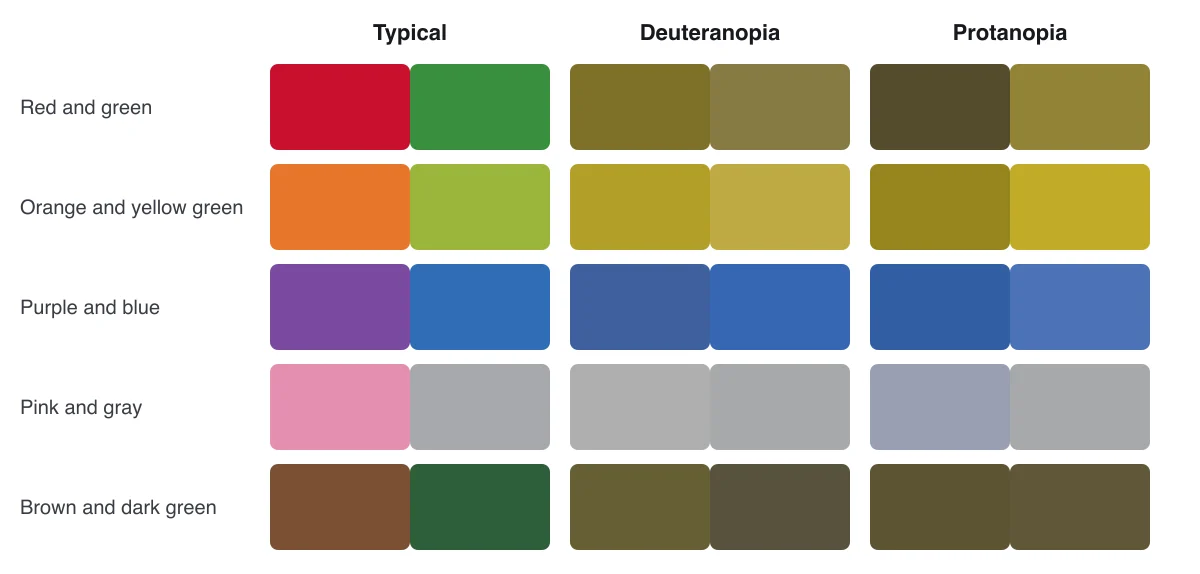
The pairs that cause trouble are the ones whose only difference is along the missing red-green line. Pink and gray is a classic: a pink shirt can look gray, and a gray one pink. Purple and blue collapse because the red in purple disappears. Brown and dark green become one dark olive.
Blue-yellow types
With tritanopia, colors are seen along a red to cyan line. Blue and green look alike, yellow looks pinkish or light gray, and dark blue reads close to black. Tritan vision is rare from birth but more common as an acquired change, for example as the eye's lens yellows with age.
Complete color blindness
Achromatopsia means no working cones. The world is seen in shades of gray, usually with strong sensitivity to light and lower sharpness, because the rods that remain are built for dim light. It affects about 1 in 30,000 people.
Where it gets in the way
- Charts, maps and dashboards that use red and green for bad and good.
- Ripeness of fruit, doneness of meat, rashes and sunburn.
- Cable colors, battery and charging lights, and the status LEDs on devices.
- Sports kits, team colors and some board games.
- Choosing clothes and paint, where the name of a color matters as much as how it looks.
- Jobs with color coding: electricians, pilots, some police and transport roles test color vision.
What helps
Most adjustments are about adding a second signal to color. Designers can use labels, patterns and icons next to colors, choose palettes that differ in lightness, and avoid red-green pairs for important meaning; the WCAG accessibility rule 1.4.1 asks that color is never the only way information is shown.
For everyday life, a color identifier that names colors in plain words helps with clothes and paint, and phone settings can apply color filters. Tinted lenses can increase contrast between some colors for some people, but they do not restore normal color vision.
A short visual explainer
This animated video shows how the cones work and what changes in each type, with simulated images like the ones above.
Questions
Do color blind people see in black and white?
Almost never. Only achromatopsia, which affects about 1 in 30,000 people, means seeing no color. Most color blind people see many colors, with fewer differences between some of them.
What colors do red-green color blind people confuse?
Red and green, orange and yellow green, purple and blue, pink and gray, and brown and dark green. The colors in each pair differ mainly along the red-green line.
How can I see what a color blind person sees?
Upload a photo to the color blindness simulator. It shows the photo as deuteranopia, protanopia, tritanopia and achromatopsia, side by side with the original.
Can color blind people drive?
Yes, in most countries. Traffic lights always keep the same order, with red at the top of a vertical light, so position tells drivers which light is on.
Related
Sources
- Machado, Oliveira and Fernandes (2009), A physiologically-based model for simulation of color vision deficiency, IEEE Transactions on Visualization and Computer Graphics 15(6)
- Colour Blind Awareness, Living with colour vision deficiency
- W3C, Web Content Accessibility Guidelines 2.2, Success Criterion 1.4.1 Use of Color
- Human Interests (YouTube), How Color Blindness Works