
What is LRV in paint?
By Burak. Updated 7 November 2026. About
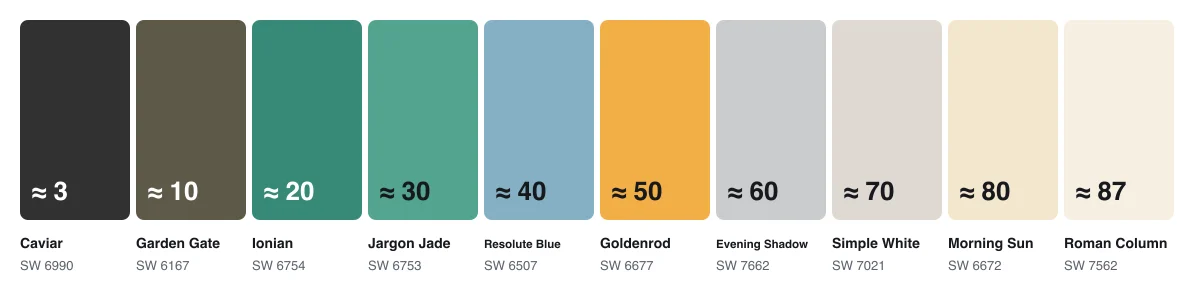
LRV (light reflectance value) is the share of visible light a paint color reflects, on a scale from 0 (black, absorbs everything) to 100 (white, reflects everything). Most whites sit between 80 and 93, mid tones between 30 and 50 and dark colors below 20. It is the most useful single number for knowing how light or dark a color will feel on a wall.
The scale with real paints
LRV measures lightness only. Two colors with the same LRV can be any hue, a blue and an orange, and they will still feel equally light in a room. That is why designers check LRV before hue when a room is dark or when two surfaces must be told apart.
What the numbers mean in a room
| LRV | Feels | Good for |
|---|---|---|
| 80 to 93 | Very light | Ceilings, north-facing and small rooms, trim |
| 60 to 79 | Light | Most walls; keeps a room bright without glare |
| 40 to 59 | Mid | Living spaces with good daylight, feature walls |
| 20 to 39 | Deep | Accent walls, doors, cabinets, cozy rooms |
| 0 to 19 | Dark | Drama, exterior trim, rooms used at night |
No paint reaches 0 or 100. The brightest whites stop around 93 or 94 and the deepest blacks around 2 or 3.
How LRV is measured
Paint makers paint a card, let it dry and measure it with a spectrophotometer. The instrument records how much light the paint reflects at each wavelength, then weights those readings by how sensitive the eye is to each wavelength. The result is the CIE Y value, defined in the CIE 15 colorimetry standard, and LRV is that value as a percentage.
Where a brand publishes LRV, our color pages show that number. Where it does not, the page calculates Y from the color's screen values and marks the result with ≈. A calculated value is a good guide; the maker's measured value is the reference.
How to use LRV when choosing paint
- In a room with little daylight, start at LRV 60 or more so the walls do not turn gray in the afternoon.
- On the ceiling, go 10 or more points above the walls to make the room feel taller.
- For a dark accent wall, keep the other walls light enough (60+) that the room still reads bright.
- For trim, pick a white within 5 points of the walls for a soft look, or 20+ points away for crisp contrast.
- Outside, remember that LRV affects heat: dark colors under 20 absorb more sun and can soften vinyl siding.
LRV and accessibility
People with low vision, and many color blind people, rely on lightness more than hue. A door the same LRV as its wall disappears even if one is green and the other red.
The UK standard BS 8300-2:2018 recommends a difference of at least 30 LRV points between surfaces that must be told apart, such as a door and the wall around it, a handrail and its wall or a step edge and the step. Many building guides elsewhere use the same rule.
- Door 25, wall 70: a 45 point difference, easy to find.
- Door 55, wall 70: 15 points, hard to see for many people.
- Floor and wall: aim for 30 points so the room edge is clear.
A short explainer
This video shows LRV on the back of real paint chips and how painters use it with clients. Our LRV checker does the same calculation for any color code or photo.
LRV is not the whole story
Two colors with the same LRV can still feel different: a warm beige feels lighter than a gray at the same LRV in a warm-lit room. Sheen matters too: gloss reflects light directly and can look brighter at some angles. Use LRV to set the lightness you need, then choose the hue and undertone you like within that range.
Questions
What is a good LRV for a living room?
Between 60 and 80 for most living rooms. Go higher in rooms with little daylight and lower if the room is very bright and you want it to feel cozier.
What LRV do whites have?
Most paint whites sit between 80 and 93. A white under 80 reads as off-white or cream on a large wall.
Does sheen change LRV?
LRV is measured on a flat sample and changes little with sheen, but gloss reflects light directly, so a glossy wall can look brighter or darker depending on where you stand.
How do I find the LRV of a color?
Most brands print it on the chip or the color's web page. For any other color, the LRV checker calculates it from the color code or a photo.